
Contents
The bedroom feels comfortable until you climb under the blanket. An hour later, the air around your legs feels warm and stuffy, although the room itself hasn’t changed much.
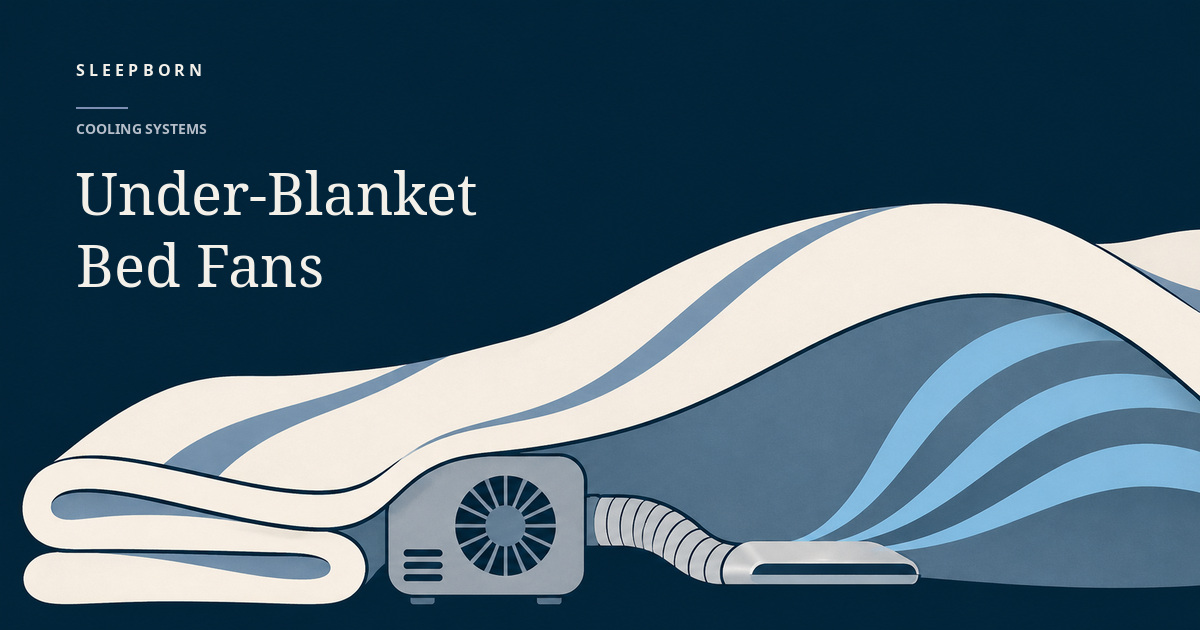
You could lower the thermostat, but that would cool the entire bedroom to solve a problem happening in a much smaller space. Under-blanket fans aim airflow directly into the bedding. Some add heating and overnight programming; others offer a simple breeze or rechargeable operation. The difference matters more than the longest feature list.
For most buyers, BedJet 3 is the most capable option, the original bFan is the simpler established alternative, and the KPUKGJDK rechargeable fan is worth investigating when cordless placement matters. None should be mistaken for a miniature air conditioner.
Can an Under-Blanket Fan Actually Cool Your Bed?
Yes, it can make the space beneath your covers feel cooler by moving trapped heat and moisture away, but typical under-blanket fans do not refrigerate the air they deliver.
Bedding slows heat exchange. The air near your body warms and can become humid. Circulating room air through that space may carry away heat and support evaporation. If the entire room is already hot, there is less cooling potential. BedJet’s specifications identify rooms below 79°F as most favorable for its cooling function.
A 2020 study in Energy and Buildings examined how bedroom temperature and bedding insulation affect conditions inside the bed. It wasn’t a commercial fan test, but its central implication matters: the room and the blanket both influence the environment a fan is trying to change.
Which Under-Blanket Bed Fan Should You Choose?
Considered by Sleepborn
BedJet 3 Climate Comfort System
Best suited for
Sleepers wanting scheduled airflow, heating, and more control during the night.
Design distinction
Mains-powered blower, hose, nozzle, remote, and programmable Biorhythm schedules.
Main compromise
Higher cost and setup complexity; cooling still uses room air.
Buying option
(Paid link) View on Amazon →
Original bFan Bedfan
Best suited for
Sleepers who want straightforward ventilation under ordinary bedding.
Design distinction
Adjustable outlet directs room air under the sheets without heating or elaborate scheduling.
Main compromise
No refrigeration or overnight programming; the original bFan is sold through its own website.
Buying option
KPUKGJDK Rechargeable Bed Fan
Best suited for
Buyers prioritizing flexible placement without continuous use of a power cable.
Design distinction
Rechargeable 10,000mAh advertised battery, five fan speeds, remote, and adjustable stand.
Main compromise
Seller-advertised high-speed runtime is about five hours; documentation and history are limited.
Buying option
(Paid link) View on Amazon →
The important distinction is how each fan delivers air, where it fits beside your bed, and whether its controls suit the way you sleep.
BedJet 3: The Most Complete Under-Blanket Airflow System
BedJet is built for someone who wants to control more than the strength of a breeze. Its blower rests under or beside the bed, delivering air through a hose and nozzle. The remote adjusts airflow and heating, while Biorhythm allows settings to change through the night.
Consider someone who feels warm at bedtime but becomes cold toward morning. A basic fan runs at one setting unless they change it. BedJet can vary its program, which is useful if the discomfort changes over time rather than remaining constant.
The distinction is control, not refrigeration. In cooling mode, BedJet moves room air. Its displayed settings shouldn’t be mistaken for an air-conditioner’s ability to chill an entire space. Installation also needs planning: the maker specifies at least six inches of under-bed clearance for positioning the main unit underneath, with side placement as an alternative.
The optional Cloud Sheet is a double-layer sheet with airflow channels. It spreads the breeze differently from ordinary bedding and can reduce a concentrated stream at the feet. It is an accessory, not a third fan or a prerequisite to basic BedJet operation. Couples who want independent control should check the specific dual-zone package rather than assume one standard unit provides it.
Best fit: An established system offering airflow, heating, and scheduled changes. Think twice if: You only want a simple constant breeze or your bedroom is persistently too hot.
BedJet 3 — buying decision
Best suited for
You need adjustable airflow and heating across the night.
Design distinction
Programmable system with an optional airflow-distribution sheet.
Main compromise
Confirm six-inch clearance, regional power compatibility, package contents, and seller terms.
Buying option
(Paid link) View on Amazon →
Original bFan: Straightforward Airflow Under Your Sheets
The original bFan solves a narrower problem. Its adjustable outlet sends room air beneath the bedding without adding programmed heating cycles or specialized air-distribution sheets. If the room itself feels comfortable and only the trapped air under the blanket becomes unpleasant, this may be enough.
Positioning still matters. The outlet needs a clear path, and tightly tucked heavy bedding can restrict movement. The manufacturer’s guidance recommends starting with lower airflow and adjusting gradually. More breeze is not automatically more comfortable, particularly when two people share the bed.
There is also an important purchasing distinction: the original manufacturer expressly says bFan is not sold on Amazon. If you want that particular model, use the manufacturer’s own buying page rather than assuming a similarly named product is identical.
Best fit: Straightforward dedicated ventilation with existing bedding. Think twice if: You need heating, an automated overnight schedule, or cordless operation.
Original bFan — buying decision
Best suited for
A constant under-sheet breeze is all you need.
Design distinction
Manufacturer-direct, adjustable bed-fan design.
Main compromise
Check outlet height and bedding path; available directly from the maker.
Buying option
KPUKGJDK Rechargeable Bed Fan: The Cordless Trade-off
Rechargeability appeals when you do not want another permanent appliance attached to an outlet. The identifiable KPUKGJDK listing (paid link), ASIN B0H7RZWCF7, advertises a 10,000mAh battery, remote control, five airflow speeds, and an adjustable stand spanning roughly 22–53 cm.
The more useful specification is runtime at the speed you actually need. The seller describes up to 22 hours on low but about five hours on high. Actual runtimes can vary with fan speed and conditions. Someone who needs strong air movement for an eight-hour night should not assume the headline maximum battery duration applies.
There is a further documentation inconsistency: the descriptive copy refers to a rechargeable battery, while a structured listing field identifies AC power. This could involve charging or inaccurate product data. Confirm the supplied power arrangement, current variant, and returns before purchasing.
Its portable design should not be mistaken for the same control or airflow system as BedJet or the original bFan. Publicly accessible long-term service evidence is thinner, so its appeal rests chiefly on placement and cordless convenience rather than established reliability.
Best fit: Flexible placement and lower-speed cordless airflow. Think twice if: You require strong, uninterrupted airflow all night or detailed after-sales documentation.
KPUKGJDK — buying decision
Best suited for
You value rechargeable placement flexibility.
Design distinction
Remote-controlled, adjustable under-cover airflow.
Main compromise
Check high-speed battery duration, outlet height, and current seller specifications.
Buying option
(Paid link) View on Amazon →
BedJet vs. bFan: What Actually Changes?
The question is not whether one product has more features. It is whether your temperature preference changes while you sleep. Both systems move room air beneath bedding. BedJet adds heating, programmable schedules, and a Cloud Sheet option; bFan focuses on adjustable ventilation under ordinary covers. Neither independently refrigerates the incoming air.
BedJet requires a location for the main unit and hose. bFan needs an outlet that meets the bedding at the right height. BedJet’s dual-zone configurations may benefit partners who want different settings; a single ordinary bed fan does not automatically provide independent zones. Without comparable independent noise tests, neither can be declared objectively quieter.
Choose BedJet for control and flexibility. Choose bFan for simpler continuous airflow. The more complicated system is only better if you will use what it adds.
What Determines Whether Under-Blanket Cooling Will Work?
First identify where the heat collects. That diagnosis is more informative than sorting products by their advertised maximum speed.
Airflow Suitability Map
Air trapped under covers
A targeted bed fan is most relevant. Keep a clear airflow path beneath bedding.
Heat against the mattress
Investigate the mattress surface or a temperature-controlled pad. Air above the body may not address it fully.
The whole room feels hot
Address room cooling first. Moving warm room air has limits.
Only one partner feels hot
Check directed airflow and real independent-zone capability rather than assuming perfect separation.
Hot at bedtime, cold near morning
Automatic scheduling is more relevant than a fan left running at one fixed speed.
Heavy or tightly tucked bedding
Try a lighter cover or a less restricted airflow path before paying for more motor power.
In a 2024 Scientific Reports study, researchers used a thermal manikin to examine passive and low-energy thermal comfort approaches, including changes to bedding insulation and air movement. It supports the principle that airflow and bedding interact. It did not test BedJet, bFan, or KPUKGJDK in sleeping people, so it cannot rank these products.
How Much Does Fan Noise Matter Overnight?
A fan that seems quiet during a brief demonstration may distract you after an hour beside your bed. Consider both the motor and the air passing through its outlet or bedding. More airflow can create more noticeable sound.
BedJet and bFan both describe quiet operation, and KPUKGJDK advertises low noise, but these claims do not provide equivalent independent measurements. The noise at the speed you actually need is more important than the claimed performance at the quietest setting.
A 2023 observational study in Sleep Health associated greater bedroom noise exposure with reduced measured sleep efficiency. It did not compare these fans or establish how any particular sleeper will react. If sound sensitivity matters, check return conditions at your actual point of purchase.
If your main goal is masking noise rather than cooling the bed, our white noise machine vs. room fan comparison discusses sound and airflow as separate needs.
When a Bed Fan Is Not the Best Cooling Solution
If the entire bedroom is excessively hot, a bed fan is not a substitute for adequate room cooling. If the problem starts when you add a thick duvet, simpler bedding may improve comfort without new equipment.
If you are changing the outer layer, our summer linen duvet-cover guide explains how the cover and insert affect warmth differently. If the mattress feels hot underneath you, airflow delivered above the mattress may fail to address the main source of discomfort.
A conventional room fan may be sufficient when the whole room feels stagnant. A water-based temperature-controlled pad is a different option when the mattress surface is the issue, although it adds cost, hardware, and maintenance. The purpose of this comparison is not to manufacture a reason to buy a specialty appliance; it is to identify whether under-cover airflow solves your particular problem.
Before You Buy: The Compatibility Check
- Measure placement: Check floor-to-mattress height, under-bed space, hose route, and whether the nozzle can meet the bedding without obstruction.
- Check power: BedJet’s North American unit uses 120-volt power; confirm your region and the exact model. For rechargeable options, look at runtime at your intended fan speed.
- Inspect the package: Do not assume BedJet’s optional Cloud Sheet or a dual-zone setup is included.
- Consider your partner: Direct airflow may reach both sleepers; verify independently controllable zones when they matter.
- Review warranty, returns, and cleaning: Manufacturer-direct policies may differ from a marketplace seller’s terms. Follow the model’s own filter and maintenance instructions.
Frequently Asked Questions About Under-Blanket Fans
Do under-blanket fans use cold air?
Most circulate room-temperature air. They may improve comfort by moving trapped heat and moisture away but do not independently refrigerate the air.
Is BedJet better than a regular bed fan?
It offers heating and programmable control that simpler fans do not. If you only want a steady breeze beneath the sheets, a simpler fan may be more appropriate.
Can you use BedJet without the Cloud Sheet?
Yes. The Cloud Sheet is optional and changes the distribution of air rather than providing a separate cooling machine.
Will a bed fan work with a thick comforter?
Potentially, but heavy or tightly tucked bedding can interfere with airflow. The cover and air pathway both matter.
Can one bed fan cool only one side?
It may target one area, but complete independence requires a configuration designed for separate zones. Check the actual system rather than assume it.
Can a rechargeable bed fan last all night?
Runtime depends on speed. The KPUKGJDK seller advertises up to 22 hours at low speed but approximately five hours at high; those are not independently measured results.
Is an under-blanket fan worth buying?
It is most relevant when the room is comfortable yet the air under the covers becomes stuffy. Room-wide heat or a hot mattress surface may require a different approach.
Which Cooling Approach Makes Sense for You?
If you want scheduled airflow, heating, and an established accessory ecosystem, BedJet 3 is the clearest option. If a steady breeze beneath ordinary sheets is sufficient, the original bFan offers a simpler approach. If cordless positioning matters, KPUKGJDK is an identifiable but less established alternative whose high-speed battery runtime deserves scrutiny.
The useful question isn’t which fan has the longest feature list. It is whether the discomfort comes from trapped air, the mattress beneath you, or the room around you. Once you know that, the equipment decision becomes much easier.


0 Comments
Questions, corrections, and useful additions are welcome.