
Contents
You straighten the mattress before bed, and by morning it has shifted toward one side of the frame again. It looks like a simple problem. Put something grippy underneath and the mattress should stay where you left it.
Sometimes that works. But a mattress can move for at least three different reasons: the mattress is sliding across its foundation, the entire bed frame is creeping along the floor, or the support beneath the mattress is loose or damaged. A non-slip pad addresses the first problem. Buying one for the other two can leave you with the same movement and one more thing tucked under the bed.
Start by identifying which surface moves. For mattress-on-base slipping, a purpose-made grip pad such as Gorilla Grip is the clearest documented starting point. TRU Lite Bedding offers a smaller twin-oriented format for certain platform or futon setups, while the Helm Futon Grip Pad is intended for a hinged futon frame. Those aren’t interchangeable installations.
What Is Actually Sliding: Your Mattress or Your Bed Frame?
Pull the bedding back so you can see the mattress edge, frame and floor. Move the mattress gently by hand without forcing the frame. If the mattress slides while the frame stays put, the contact between its underside and the support surface is the likely issue. If the frame moves relative to the floor, a pad between the mattress and frame won’t hold the bed in place. If individual slats move, hardware loosens or the platform flexes, investigate support integrity first.
Mattress Movement Diagnostic
Mattress moves; frame stays still
Consider a mattress-specific grip pad placed between mattress and support.
Entire bed moves on the floor
Investigate bed-leg traction, floor-safe feet and frame stability instead.
Slats, platform or hardware shift
Repair or replace the faulty support. Grip material is not a structural fix.
Mattress slides during base articulation
Check the adjustable-base maker’s approved retainer system before adding material.
This distinction matters especially with adjustable bases. Raising the head changes the direction of forces on the mattress, and some bases rely on a mattress retainer bar. An unapproved layer can interfere with the manufacturer’s intended arrangement. Check the base manual before improvising with adhesive strips or a general-purpose rug pad.
Best Non-Slip Mattress Pads and Grip Materials to Consider
Considered by Sleepborn
Gorilla Grip Non-Slip Mattress and Sofa Gripper
Best suited for
Standard mattresses on compatible platform beds or box springs where the mattress slides across a stable base.
Design distinction
Dual-sided, open-weave grip material, sold in mattress-oriented dimensions and designed to be trimmed.
Check before buying
Match the actual surface and mattress size; hand wash according to the manufacturer.
Buying decision
Confirm the exact size, mattress-base compatibility and Amazon variant before choosing this product.
(Paid link) View on Amazon →
TRU Lite Bedding Non-Slip Mattress Pad
Best suited for
People considering a smaller grip pad for a platform or futon mattress.
Design distinction
A non-adhesive grip-pad listing aimed at platform and futon use rather than a full mattress protector.
Check before buying
Compare the dimensions with your mattress and check the care instructions before purchase.
Buying decision
Confirm the exact size, mattress-base compatibility and Amazon variant before choosing this product.
(Paid link) View on Amazon →
Helm Pad Company Non-Slip Futon Grip Pad
Best suited for
A futon mattress that creeps down a convertible or slatted futon seat.
Design distinction
Purpose-oriented 24-by-60-inch polyester-and-vinyl grip pad placed between futon mattress and frame.
Check before buying
The narrower pad is not a substitute for measuring a standard queen or king bed’s required coverage.
Buying decision
Confirm the exact size, mattress-base compatibility and Amazon variant before choosing this product.
(Paid link) View on Amazon →
These three formats address different contact surfaces. Product suitability depends on the actual base and mattress, not a universal “best grip” score. Their dimensions and intended contact surfaces matter more than treating every gripper as interchangeable.
Gorilla Grip: The Best-Documented General Mattress Option
Gorilla Grip provides a broad, dual-sided gripping surface for a standard mattress on a compatible foundation. Its manufacturer product page specifies a dual-sided, open-weave gripper designed to sit between a mattress and a box spring or platform surface. The pad doesn’t use a permanent adhesive bond: friction on both sides is meant to reduce relative movement.
The manufacturer lists mattress-oriented sizes, including a queen at 54 by 72 inches and a king at 72 by 72 inches. Those dimensions are intentionally smaller than standard mattress footprints, so a correctly placed pad can remain hidden beneath the bed. Gorilla Grip also says the material can be trimmed with scissors for unusual setups.
It’s tempting to treat “works on platform beds” as a guarantee for every surface. It isn’t. A rough, unfinished wooden deck, widely spaced slats and a slick metal platform present different contact patterns. The pad can only grip where its material actually touches the mattress and foundation. A large gap between slats doesn’t suddenly become a supporting surface because mesh spans it.
Care requirements also matter. Gorilla Grip specifies hand washing, not routine machine washing. If your sleeping setup requires frequent laundering, that is worth considering before purchase.
Best fit: A stable bed with a mattress sliding over a suitable foundation. Think twice if: The support structure itself shifts, your mattress manufacturer prohibits added layers, or the base offers very little usable contact area.
(Paid link) View on Amazon →
TRU Lite Bedding: A Smaller Platform or Futon Option
TRU Lite Bedding’s twin-oriented non-slip pad is intended for smaller mattress and platform arrangements. That makes it a possible alternative when the job is smaller than securing a large conventional bed.
The twin option is described as PVC foam, but its listed measurements are not consistent across the product details. Compare the actual dimensions with the area you need to grip before ordering, particularly if you need the pad to sit neatly beneath a specific mattress.
That makes accurate sizing more important than the product’s general description as a mattress gripper.
Best fit: A smaller platform or futon installation where the current product dimensions prove suitable. Think twice if: You need assured coverage of a full-size mattress or manufacturer-documented compatibility with a delicate sleep surface.
(Paid link) View on Amazon →
Helm Futon Grip Pad: When the Mattress Slides on a Futon Frame
A futon mattress behaves differently from a conventional flat bed. When a frame converts between sitting and sleeping positions, gravity and movement can pull the mattress down the seat. A wide mattress gripper isn’t necessarily the most elegant fix for that geometry.
Helm Pad Company’s documented futon grip pad is approximately 24 by 60 inches. Its listing describes a polyester fabric with a vinyl compound, designed to sit between the futon mattress and the seating portion of the frame. The manufacturer’s intended use is important here: it’s a futon-specific contact pad, not a full-size mattress foundation or a substitute for a broken hinge.
A narrower strip can make sense where the sliding force is concentrated along a futon seat, but the same dimensions may offer too little grip area beneath a large conventional mattress. Before buying, measure both the contact zone and how the frame folds. Don’t let the pad obstruct joints, hinges or any manufacturer-required clearance.
Best fit: A futon mattress creeping on an intact convertible frame. Think twice if: You need broad coverage beneath a conventional bed or the frame hardware itself is faulty.
(Paid link) View on Amazon →
How a Mattress Grip Pad Works
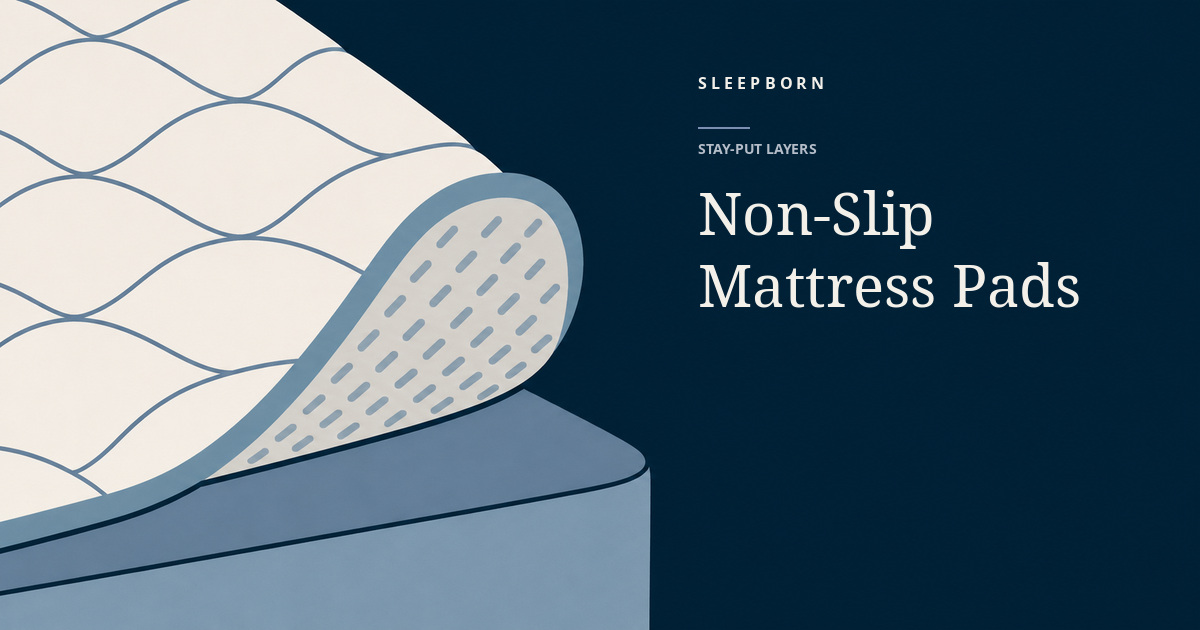
A grip pad doesn’t attach the mattress permanently to its foundation. It introduces a high-friction layer between two surfaces that would otherwise slide against each other. The material needs contact on both sides. Its effectiveness can change with the surface finish, mattress weight, area covered, dust, humidity and the direction of movement.
Open-weave grippers are different from waterproof mattress protectors. A waterproof protector is generally designed to protect a mattress from spills or moisture, often on top of the mattress under the sheet. A mattress gripper belongs between the mattress and its support. It does not replace a mattress protector. Products that are marketed as “non-slip mattress pads” can refer to either job, so look at the intended placement before interpreting a shopping result.
Gorilla Grip describes its own mesh as open-weave to allow air circulation. That design feature is not proof that every mattress and foundation combination will meet the mattress maker’s ventilation requirements. The manufacturer’s base-compatibility instructions remain authoritative.
How to Choose the Right Pad for Your Foundation
Solid platform: Confirm the surface is clean, dry and compatible with a non-adhesive gripper. The more complete contact area may make a flat grip sheet practical.
Wooden slats: Verify that the mattress is properly supported first. A thin mesh can reduce movement where it contacts slats, but it cannot correct excessive slat spacing, bowing or missing rails.
Box spring: Check the fabric surface and the mattress underside. A pad made for mattress-to-foundation friction may be appropriate, provided both components permit additional layers.
Adjustable base: Look for the supplied or manufacturer-approved mattress retainer and accessory instructions. Ordinary anti-slip mesh isn’t automatically compatible with moving base sections.
Futon: Identify whether the mattress slides on the seat, back or both during conversion. A futon-specific pad such as Helm is most relevant when the frame is sound and the mattress contacts the intended area.
How to Install a Non-Slip Mattress Pad
- Check the bed first. Tighten only hardware the manufacturer permits, replace damaged support components, and confirm the frame is stable.
- Check surface compatibility. Read both the pad maker’s instructions and the mattress or base manual, especially for foam mattresses, delicate covers and adjustable foundations.
- Clean and dry the contact surfaces. Dust and debris can affect grip. Avoid residues from cleaners or adhesives.
- Lay the pad flat. Center it on the supported area without folds or protruding edges. Trim only when the product explicitly allows trimming.
- Lower the mattress carefully. Recheck alignment and ensure the pad isn’t bunched under one corner.
- Monitor movement. After several nights, lift the mattress if necessary and check for creeping, fabric marks, wrinkles or unintended moisture accumulation.
For Gorilla Grip, the manufacturer specifically instructs users to lift the mattress, lay the gripper on the platform or box spring and replace the mattress. Its care instructions specify hand washing.
Why Your Mattress May Still Slide After Adding a Pad
If the mattress continues to migrate, resist the urge to stack more layers immediately. The pad may be placed at the wrong interface, cover too little of the actual contact area, or be sliding together with a loose foundation cover. It could also be losing grip because the surface is dusty or incompatible.
Sometimes the problem is geometric. A mattress that’s smaller than its frame can shift into unused space; a steep adjustable-base position may create a stronger downhill force than the pad can resist. A damaged platform or unsecured slat may move with the mattress. In each case, stronger mesh alone may not provide a lasting answer.
Try to observe which two surfaces separate during movement. That’s more useful than buying the grippiest-looking product.
When a Retainer or Frame Repair Is Better Than a Pad
When the bed frame slides on the floor, the fix belongs at the bed legs or floor interface. Choose floor-safe protection appropriate to the surface; don’t assume rug grippers are suitable for mattress contact or finished flooring.
When the mattress shifts on an adjustable base, a correctly fitted mattress retainer may be the intended solution. Use the base manufacturer’s approved parts and fitting procedure. When a rail or slat is broken, repair the support rather than conceal the defect with friction material. A grip pad cannot make an unsafe structure sound.
And if you’re dealing with an ordinary platform bed and modest mattress drift, the first solution might cost nothing: clean the surfaces, confirm mattress alignment, and verify that the bed is properly assembled.
Frequently Asked Questions
Where does a non-slip mattress pad go?
A mattress gripper usually sits between the mattress underside and a compatible platform or box spring. That is different from a mattress protector placed over the mattress.
Can a mattress grip pad damage the mattress?
Compatibility depends on the materials, finishes and maker’s instructions. Check whether your mattress and base permit added grip layers, and inspect periodically for marks or trapped moisture.
Will a mattress gripper work on slats?
It may increase friction where the pad contacts intact slats, but it doesn’t repair missing supports or compensate for an unsuitable slat spacing.
Can I use a rug gripper under my mattress?
Don’t assume so. Rug pads are engineered and labeled for different surfaces, and some carry finish restrictions. A purpose-made mattress gripper with compatible instructions is the more direct starting point.
What if the entire bed slides?
A pad placed beneath the mattress won’t stop the frame moving across the floor. Investigate bed-leg grip, floor compatibility and frame stability instead.
If you are also considering raising the frame, our bed-riser guide explains leg fit and stability; risers are not a fix for a sliding frame.
Do I need a larger grip pad for a heavier mattress?
Weight alone doesn’t determine the right pad. The supported contact area, material, frame geometry and product size matter. Follow the gripper manufacturer’s sizing and installation guidance.
Choose the Fix Before Choosing the Product
A non-slip mattress pad can be useful, but only when the mattress is actually slipping against a stable support. Gorilla Grip offers a clearly documented general-purpose mattress gripper. TRU Lite Bedding suits a smaller platform or futon setup when its dimensions fit. Helm’s narrow pad is intended for a futon frame rather than a large conventional bed.
Those differences are more important than pretending every product belongs on every bed. Identify the moving interface, confirm the base is sound, and choose a grip material that has enough appropriate contact. If the structure needs repair, repair it. The right purchase begins with knowing which problem you’re solving.




0 Comments
Questions, corrections, and useful additions are welcome.